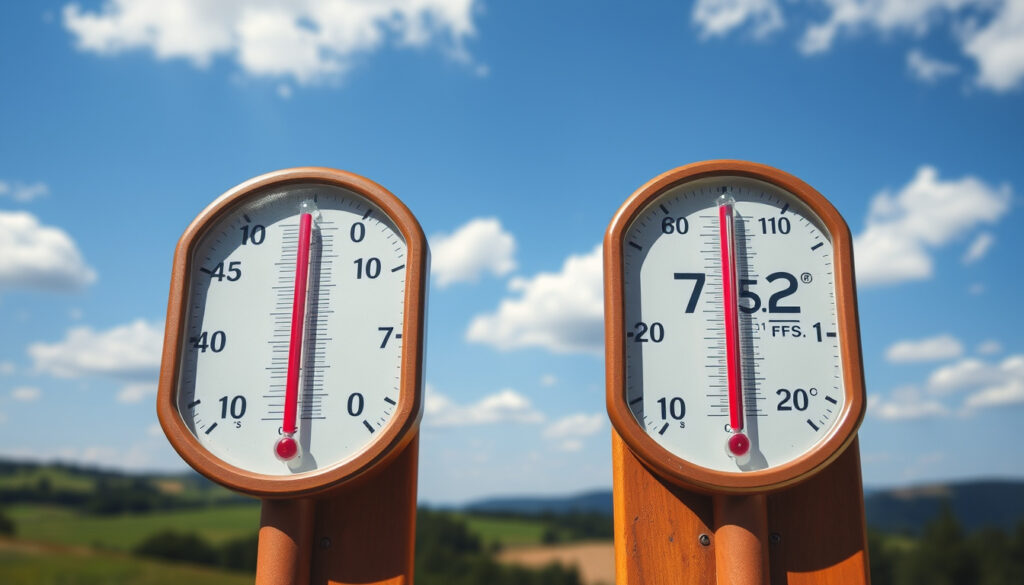
24 Degrees Celsius to Fahrenheit – Exact 75.2°F Conversion Guide
Converting 24 degrees Celsius to Fahrenheit yields exactly 75.2°F using the standard formula °F = (°C × 9/5) + 32. This temperature falls within the mild-to-warm range that most people find comfortable, whether indoors or during outdoor activities in temperate climates.
Temperature conversions between Celsius and Fahrenheit are needed across cooking, scientific work, weather reporting, and international travel. Understanding the relationship between these two scales helps when reading product specifications, interpreting forecasts, or following recipes from different countries.
23 Celsius to Fahrenheit: Nearby Conversions
Temperatures between 20°C and 26°C represent common ranges for everyday comfort, indoor environments, and mild weather conditions. The following table provides exact conversions for values surrounding the primary topic of 24°C.
| Celsius (°C) | Fahrenheit (°F) | Context |
|---|---|---|
| 20 | 68.0 | Cool room temperature |
| 21 | 69.8 | Standard room temperature |
| 22 | 71.6 | Mild |
| 23 | 73.4 | Mild, comfortable |
| 24 | 75.2 | Warm, comfortable |
| 25 | 77.0 | Warm |
| 26 | 78.8 | Warm |
Values above derive from multiplying each Celsius value by 9/5, then adding 32. All figures match data from multiple independent conversion tables with consistency across sources.
- 24°C equals exactly 75.2°F, verified across all reference sources
- The conversion formula is °F = (°C × 9/5) + 32
- The reverse formula is °C = (°F − 32) × 5/9
- Zero degrees Celsius (0°C) corresponds to 32°F, the freezing point of water
- Body temperature (37°C) equals 98.6°F under the same formula
- The boiling point of water is 100°C or 212°F
- Absolute zero (−273.15°C) equals −459.67°F
To estimate Fahrenheit from Celsius without a calculator, double the Celsius value, take 10% off that number, then add 32. For 24°C: double is 48, 10% is 4.8, subtract gives 43.2, add 32 equals 75.2°F.
24 Degrees Celsius Hot or Cold
Whether 24°C feels hot or cold depends on context, acclimatization, and what activities are planned. In general, 24°C registers as warm but comfortable for most people in temperate regions.
Indoor Comfort Standards
Building codes and energy recommendations often cite 24°C as the upper end of acceptable indoor temperatures during summer months. This level provides a comfortable environment for sedentary activities without requiring air conditioning in milder climates. Office guidelines frequently recommend settings between 20°C and 24°C for optimal productivity and comfort.
Outdoor Perception
For outdoor activities, 24°C offers pleasant conditions for walking, cycling, or light recreation. Direct sunlight can make this temperature feel warmer, while shade or breeze introduces cooling effects. Higher altitudes or lower humidity can alter the perceived warmth significantly. According to the National Weather Service, heat index values become a concern when ambient temperatures exceed these ranges during prolonged exposure.
People living in cooler northern regions often perceive 24°C as distinctly warm, while residents of tropical areas may consider it mild or even cool. Research on thermal comfort confirms that adapted populations develop different expectations based on their local climate norms.
Cooking and Food Safety
Temperature awareness matters significantly in cooking and food storage. Room-temperature foods left in 24°C conditions should not exceed two hours before refrigeration to prevent bacterial growth. Understanding these thresholds helps maintain proper food safety practices. The FDA provides detailed guidelines on temperature control for food safety that complement these basic principles.
Celsius to Fahrenheit Chart
Conversion charts serve as practical references for quick lookups without performing calculations each time. These tools prove especially valuable in kitchens, laboratories, and industrial settings where frequent conversions occur.
Understanding the Two Scales
The Celsius scale, devised by Anders Celsius in 1742, originally set water’s boiling point at 0°C and freezing point at 100°C—opposite to the modern convention. The scale was reversed after his death. Today, Celsius aligns with the metric system and serves as the standard for scientific work worldwide.
The Fahrenheit scale, introduced by Daniel Gabriel Fahrenheit in 1724, established zero at the lowest temperature achievable with a salt and ice mixture. This historical difference creates the 32-degree offset between the two scales at the freezing point of water.
Celsius belongs to the metric system developed in France during the 1790s, while Fahrenheit remains part of the customary units still used in the United States. The choice of scale often reflects regional standards rather than any scientific advantage.
Reading Temperature Charts
Effective chart usage involves identifying the known scale, locating the value, and reading the corresponding result. Interpolation between listed values works reliably for most practical purposes. For instance, values between 24°C (75.2°F) and 25°C (77.0°F) follow a linear progression of 1.8°F per Celsius degree.
Charts covering broader ranges typically include extreme values like absolute zero (−273.15°C) at the low end and elevated temperatures such as 40°C (104°F) at the high end. Extended charts found in engineering references may span from −40°C to several hundred degrees Celsius. The Engineering Toolbox provides comprehensive conversion charts suitable for professional applications.
Terminology Note
The term centigrade sometimes appears interchangeably with Celsius, though technically it represents an older designation. The name centigrade was officially abandoned in favor of Celsius in 1948 to honor Anders Celsius. Both terms describe identical conversions and measurements.
Certainty and Precision in Temperature Conversion
Temperature conversion between Celsius and Fahrenheit produces mathematically exact results with no ambiguity. The formula yields consistent values regardless of atmospheric pressure, humidity, or other conditions that might affect actual temperature readings.
| Aspect | Status |
|---|---|
| 24°C to °F conversion result | 75.2°F, mathematically exact |
| Formula accuracy | Verified across all reference sources |
| Conversion direction | Reversible using inverse formula |
The precision of temperature conversions depends only on the arithmetic involved. No estimates, approximations, or rounding are necessary for standard conversions at typical everyday temperatures. Decimal precision typically extends to one place for practical use.
Background and Practical Context
Temperature scales developed independently across different regions and purposes. Celsius gained adoption through scientific institutions and eventually most national weather services. Fahrenheit remains prevalent in the United States for consumer applications, though scientific and medical contexts there also use Celsius.
International travel, global commerce, and scientific collaboration all require comfortable navigation between these scales. Recipes originating in different countries, equipment specifications from international manufacturers, and weather information from foreign sources all benefit from clear understanding of both measurement systems.
For more measurement and conversion resources, see our guide to 1 Cup to Grams – Precise Conversions for Baking Ingredients which covers common kitchen conversion needs.
Sources and References
Conversion formulas and verified tables from multiple independent sources confirm the relationship between temperature scales. These references include commercial conversion tools, educational materials, and official measurement resources.
Key references include the National Institute of Standards and Technology for metric system context, the National Physical Laboratory for temperature measurement standards, and conversion tools from multiple electronics distributors that maintain verified calculation accuracy. The National Weather Service also publishes heat index charts that incorporate temperature conversions for public safety applications.
Summary
Twenty-four degrees Celsius converts to exactly 75.2°F using the established formula. This temperature represents comfortable, warm conditions suitable for indoor environments and mild outdoor activities in temperate climates. The conversion is mathematically precise with no variation across sources.
For currency and measurement conversion tools, explore our resource on 101 USD to CAD – Live Converter and Exchange Rate.
Frequently Asked Questions
26 Celsius to Fahrenheit?
26°C equals 78.8°F. The calculation follows the standard formula: (26 × 9/5) + 32 = 78.8.
18 Celsius to Fahrenheit?
18°C equals 64.4°F. Applying the formula: (18 × 9/5) + 32 = 64.4.
What is the Fahrenheit to Celsius formula?
The reverse conversion uses °C = (°F − 32) × 5/9. For example, 73°F converts to approximately 22.8°C.
40 degrees centigrade fahrenheit?
40°C equals 104°F. This marks the upper range of comfortable temperatures and corresponds to typical summer heat advisories in many regions.
69 degrees celsius to fahrenheit?
69°C equals 156.2°F. This temperature falls well above human comfort ranges and into industrial or sterilization applications.
More related posts
 Things to Do in Amsterdam: Top Attractions, Costs & Itinerary
 90 Day Fiancé Before the 90 Days – Seasons, Cast and Viewing Guide
 Redmi 10 Prime to Buy – ₹9,990 Prices on Flipkart India
 Toyota C-HR – 2025 Specs Pricing MPG Guide
 Toronto South Detention Centre: Visits, Address & Funds Guide
 Bishop McNally High School: History, Location, Schedule, and More
 National Day for Truth and Reconciliation: Meaning, History & Observance
 Are the Blue Jays Playing Today? Schedule, Time, TV Channel
