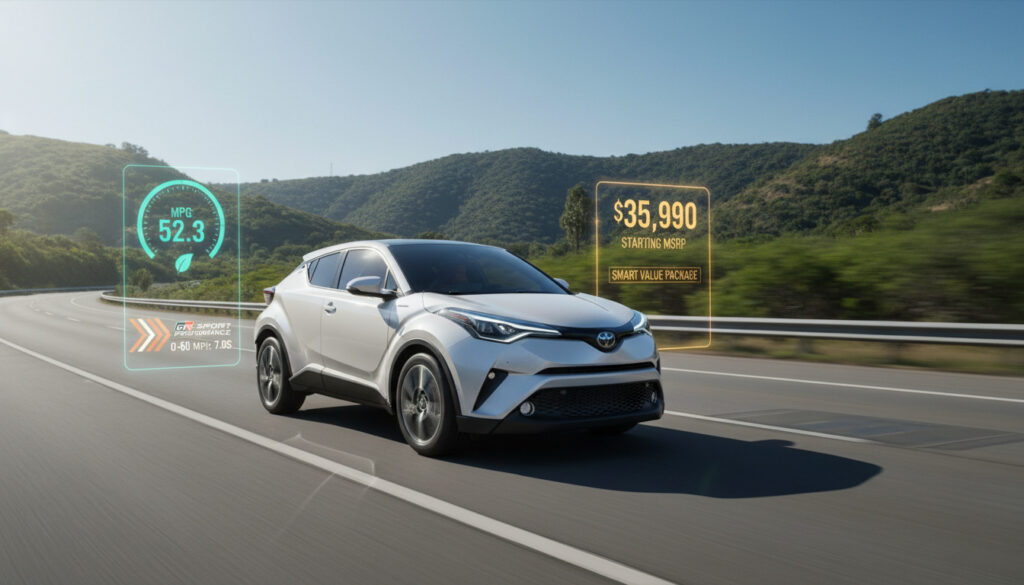
Toyota C-HR – 2025 Specs Pricing MPG Guide
The Toyota C-HR occupies a distinctive niche in the subcompact crossover segment, blending coupe-like styling with hybrid efficiency. Originally positioned as Toyota’s entry into the crowded small SUV market, the second-generation model arriving for 2025 refines the formula with improved interior space and advanced powertrain options.
Global markets receive a thoroughly revised hybrid system for the 2025 model year, while the United States prepares for a significant pivot—the 2026 model will debut as a fully electric vehicle with substantially more power and range than its predecessor. This divergence creates a complex landscape for prospective buyers evaluating the C-HR against competitors like the Honda HR-V and Toyota’s own RAV4.
Understanding the specifications, pricing structures, and regional availability differences proves essential for consumers considering this stylish compact utility vehicle.
What Is the Toyota C-HR?
The C-HR (Coupe High-Rider) represents Toyota’s attempt to bridge the gap between traditional hatchbacks and compact SUVs. According to Wikipedia, the original generation debuted in 2016, with the second generation launching globally for 2025 featuring significant architectural updates.
- Second-generation platform introduces increased rear passenger space and cargo versatility
- Hybrid-only powertrain strategy for 2025 in most international markets
- Maintains distinctive coupe-SUV silhouette with sharpened LED lighting signatures
- All-wheel-drive capability available exclusively with the larger 2.0L hybrid system
- United States market skips the 2025 hybrid entirely in favor of a 2026 EV launch
- Positioned below the RAV4 in Toyota’s SUV hierarchy with emphasis on urban maneuverability
| Specification | Details |
|---|---|
| Engine Options | 1.8L or 2.0L Petrol-Electric Hybrid |
| Power Output | 138 hp (1.8L) / 194 hp (2.0L) |
| Transmission | Electronic CVT (eCVT) |
| Length | 4,390 mm (172.8 in) |
| Width | 1,795 mm (70.7 in) |
| Height | 1,565 mm (61.6 in) |
| Wheelbase | 2,640 mm (103.9 in) |
| Cargo Volume | 377 liters (13.3 cu ft) |
| Curb Weight | ~1,575 kg (3,472 lb) AWD |
| Fuel Tank | 43 liters (11.4 gal) |
What Are the Key Toyota C-HR Specs?
Powertrain Configurations
The 2025 C-HR offers two distinct hybrid powertrains. Specifications from Saudi Arabian market data confirm the entry-level 1.8L system produces 138 horsepower combined, utilizing a 72 kW engine paired with a 70 kW front electric motor. This configuration drives the front wheels exclusively through an electronic continuously variable transmission.
The upgraded 2.0L hybrid available in GR Sport and higher trims generates 194 horsepower, combining a 112 kW engine with front and rear electric motors. This variant offers Toyota’s AWD-i (All-Wheel Drive with intelligence), employing a 30 kW rear motor to enhance traction without the weight penalty of traditional mechanical all-wheel-drive systems.
Dimensions and Practicality
The 377-liter trunk capacity represents a modest improvement over the previous generation, though it remains smaller than the Honda HR-V’s 430 liters and significantly below the Toyota RAV4’s expansive cargo area. Rear seats offer adequate space for the subcompact segment, with the second generation addressing criticisms of the original’s cramped rear quarters.
Australian reviews from CarExpert note the improved interior packaging, with particular attention to rear knee room and shoulder width. The vehicle’s 4,390 mm overall length places it among the more compact entries in the subcompact SUV category, facilitating easier parking in dense urban centers.
Safety Equipment
Standard safety equipment includes anti-lock braking systems (ABS), electronic brakeforce distribution (EBD), front and rear parking sensors, and a rear-view camera. While the first generation earned respectable safety scores, Toyota dealerships note that comprehensive IIHS or NHTSA testing for the second-generation model remains pending as of early 2025.
How Much Does the Toyota C-HR Cost?
Global Pricing Structure
Pricing data for the 2025 model remains limited geographically, with Saudi Arabian listings indicating a starting point around SAR 101,660—approximately $27,000 USD at current USD to CAD Exchange Rate conversions for North American context. This positions the C-HR competitively against the Honda HR-V while undercutting most Toyota RAV4 configurations.
Trim Level Breakdown
Common global trims include the Dynamic Hybrid (entry), GXL (mid-grade with enhanced infotainment), Koba (premium features), and GR Sport (performance-oriented styling with AWD). The GR Sport commands a significant premium but includes distinct suspension tuning, larger alloy wheels, and exclusive exterior accents.
United States consumers awaiting the 2026 EV variant should anticipate base pricing between $30,000 and $40,000 based on segment analysis, though Toyota has not released official MSRP figures for the North American electric launch.
Is the Toyota C-HR Hybrid and What’s Its Fuel Economy?
Hybrid System Architecture
Yes, the 2025 C-HR functions exclusively as a hybrid in global markets, with no pure combustion or plug-in variants offered. The system operates as a traditional “full hybrid” or self-charging hybrid, capturing regenerative energy during braking to power the electric motor without requiring external charging infrastructure.
Real-World Efficiency
While Toyota claims up to 25.6 km/L (approximately 60 mpg US) for the 1.8L hybrid, independent testing recorded consumption closer to 5.4 L/100km (43-44 mpg) in mixed driving. The 2.0L hybrid with AWD typically achieves 4.1 to 5.4 L/100km depending on conditions—still significantly more efficient than non-hybrid competitors.
The 2026 EV Transition (U.S. Market)
American consumers should note that the 2025 hybrid C-HR will not reach North American dealerships. The region transitions directly to a fully electric 2026 model featuring dual motors producing 338 horsepower and a 287-mile EPA range from a 67 kWh battery pack. Car and Driver reports this represents a fundamental shift from the efficiency-focused hybrid strategy employed globally.
Official Toyota documentation confirms the 2026 EV utilizes a dedicated electric platform distinct from the bZ4X, featuring standard all-wheel drive and 150 kW DC fast charging capability. The 0-60 mph acceleration time of 4.9 seconds contrasts sharply with the hybrid’s 9.9-11 second performance.
How Has the C-HR Evolved Since Its Debut?
- – Conceptual debut at Geneva Motor Show; production begins in Turkey and Japan for global distribution
- – North American market introduction, filling the gap below the RAV4 in Toyota’s lineup
- – Mid-cycle refresh introducing updated infotainment systems and minor styling revisions
- – Conclusion of first-generation production in select markets; preparation for platform transition
- – Second-generation launch across European and Asian markets with entirely new hybrid powertrains
- – Projected U.S. market launch of battery-electric C-HR on dedicated EV architecture
What Details Are Confirmed and What Remains Uncertain?
Established Facts
- 2025 model offers 1.8L and 2.0L hybrid powertrains globally with confirmed output figures
- Exterior dimensions fixed at 4390mm length, 1795mm width, 2640mm wheelbase
- All-wheel-drive availability confirmed exclusively with 2.0L hybrid configuration
- 2026 U.S. EV variant confirmed with 338 hp output and 287-mile EPA range
- Standard safety features include ABS, EBD, and parking sensors across all trims
Pending Information
- Official EPA fuel economy certification for U.S.-bound vehicles remains unpublished
- IIHS Top Safety Pick status for second generation not yet awarded or tested
- Exact U.S. pricing for the 2026 EV variant including destination charges
- Battery warranty specifics and degradation coverage for new electric platform
- Long-term reliability data for the second-generation hybrid systems
How Does the C-HR Fit in the Competitive Landscape?
Within Toyota’s hierarchy, the C-HR serves as the style-forward alternative to the utilitarian RAV4. While the RAV4 emphasizes cargo capacity (over 1,000 liters) and towing capability, the C-HR prioritizes urban maneuverability and distinctive aesthetics. This positioning comes at the cost of practicality—the C-HR’s 377-liter trunk and sloping roofline limit its utility for family road trips compared to boxier competitors.
Against the Honda HR-V, the C-HR counters with superior fuel efficiency (hybrid vs. conventional powertrain) and more aggressive styling, though the Honda offers greater cargo flexibility and lower entry pricing. When referencing competitor specifications, consult the APA 7th Edition Citation Guide for proper attribution standards in automotive research.
The vehicle targets urban professionals seeking premium design elements without the parking challenges of larger crossovers. Its hybrid powertrain particularly appeals to European and Asian markets with high fuel costs and congestion charges favoring electrified vehicles.
What Do Industry Experts and Test Data Reveal?
The second-generation C-HR addresses previous criticisms of rear-seat space while maintaining the sharp handling characteristics that distinguished the original. The 2.0L hybrid delivers genuinely spirited acceleration for the segment, though the CVT transmission occasionally produces the characteristic drone under hard acceleration.
— CarExpert Review
The transition to an EV-only strategy for the U.S. market represents Toyota’s acknowledgment that American buyers seeking small crossovers increasingly demand zero-emission options. The 338-horsepower dual-motor setup transforms the C-HR from an economy-minded urban runabout into a genuinely quick subcompact utility vehicle.
— Car and Driver Analysis
Is the Toyota C-HR Worth Considering?
The 2025 Toyota C-HR delivers compelling value for buyers prioritizing efficiency and distinctive styling in a manageable footprint. Its hybrid powertrains provide exceptional economy without range anxiety, while the second-generation improvements address the original’s packaging limitations. However, North American buyers must weigh the one-year wait for the fully electric 2026 model against immediate needs, and global consumers should verify that the 377-liter cargo capacity accommodates their lifestyle requirements. With Toyota’s established hybrid reliability record and competitive pricing near the USD to CAD Exchange Rate equivalent of $27,000, the C-HR remains a calculated choice for urban-focused drivers.
Frequently Asked Questions
Is the Toyota C-HR available with all-wheel drive?
Yes, but only with the 2.0L hybrid powertrain. The AWD-i system uses a dedicated rear electric motor rather than mechanical driveshafts, providing enhanced traction during acceleration and slippery conditions while maintaining fuel efficiency.
How does the C-HR compare to the Honda HR-V?
The C-HR offers superior fuel economy through its hybrid system (43-60 mpg vs. 28-30 mpg) and more distinctive styling, while the HR-V provides greater cargo capacity (430L vs. 377L) and typically lower base pricing.
What is the expected lifespan of the C-HR hybrid battery?
Toyota hybrid batteries typically remain functional for 10 to 15 years under normal operating conditions. The second-generation C-HR utilizes updated battery chemistry, though specific warranty terms vary by market.
Why isn’t the 2025 C-HR available in the United States?
Toyota elected to skip the 2025 hybrid model for North America, transitioning the C-HR to a dedicated battery-electric platform for the 2026 model year to meet evolving emissions regulations and consumer demand.
Can the C-HR accommodate child safety seats comfortably?
The second generation improves rear-seat legroom significantly, allowing for rear-facing child seats behind average-height front occupants. However, the sloping roofline may limit headroom for taller teenagers in booster seats.
What maintenance does the hybrid system require?
Beyond standard oil changes and brake service, the hybrid system requires minimal maintenance. The eCVT transmission operates without traditional fluid changes, and regenerative braking extends brake pad life substantially compared to conventional vehicles.
More related posts
 Royaume de la Tarte – Québec City’s Historic Tart Bakery
 Detroit Lions Game Today – Offseason Update & 2025 Recap
 Halloween Movies in Order: Full Guide to All 13 Films
 Sunderland A ociation Football Club: Hi tory, Fan , and Iri h Connection
 Delhi Capitals vs Gujarat Titans Timeline: 2026 Head-to-Head
 Wordle Today New York Times: Hints, Answers & How to Play
 St-Hubert Menu Livrai on: Price & Ordering Guide
 24 Degrees Celsius to Fahrenheit – Exact 75.2°F Conversion Guide
