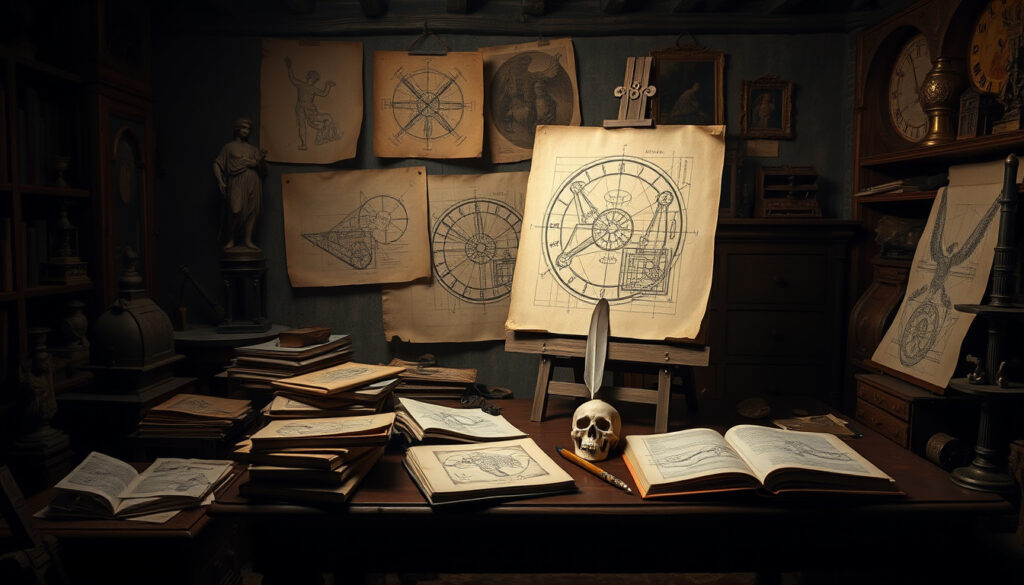
Leonardo da Vinci: Life, Death, and Unanswered Mysteries
Few historical figures still spark as much curiosity as Leonardo da Vinci, and beyond the Mona Lisa’s famous smile lies a life full of unanswered questions about his relationships, health, and even his final words. This article separates documented facts from centuries of speculation, drawing on historical records and museum archives.
Born: April 15, 1452, Vinci, Italy ·
Died: May 2, 1519, Amboise, France ·
Known for: Painting, drawing, engineering, anatomy, invention ·
Famous works: Mona Lisa, The Last Supper, Vitruvian Man ·
Surviving paintings: Fewer than 20 attributed ·
Patron: Ludovico Sforza, King Francis I
Quick snapshot
- Leonardo never married (Wikipedia (encyclopedic reference))
- He painted the Mona Lisa and The Last Supper (Encyclopædia Britannica (historical encyclopedia))
- He died in 1519 at Clos Lucé (Encyclopædia Britannica)
- He was left-handed and wrote in mirror script (Wikipedia)
- He was born in 1452 in Vinci (Wikipedia)
- Exact cause of death (Photograph France (travel history blog))
- Whether he had a disability like dyslexia or ADHD (Wikipedia)
- His sexual orientation (Wikipedia)
- Identity of his lover(s) (Wikipedia)
- Veracity of reported deathbed words (Wikipedia)
- 1476 – sodomy accusation in Florence (Wikipedia)
- 1516 – moved to France with Melzi (Encyclopædia Britannica)
- 1519 – died May 2, burial delayed until August 12 (Photograph France)
- Ongoing research into his thousands of notebook pages (The Metropolitan Museum of Art (museum archive))
- Museums continue to study his works with new imaging technology (The Metropolitan Museum of Art)
Six key facts, one pattern: the contrast between what we know for certain and the many gaps that still invite debate.
| Label | Value |
|---|---|
| Name | Leonardo di ser Piero da Vinci |
| Birth | April 15, 1452, Vinci, Republic of Florence |
| Death | May 2, 1519, Amboise, Kingdom of France |
| Occupation | Painter, draughtsman, engineer, scientist, theorist, sculptor, architect |
| Famous for | Mona Lisa, The Last Supper, Vitruvian Man, scientific notebooks |
| Patron | Ludovico Sforza, Cesare Borgia, King Francis I |
Why is Leonardo da Vinci so famous?
The Mona Lisa and The Last Supper
- The Mona Lisa, housed at the Louvre Museum (world art institution), is arguably the most recognized painting in the world. Its enigmatic smile and sfumato technique have fueled endless analysis.
- The Last Supper, painted 1495–1498 at the monastery of Santa Maria delle Grazie in Milan (Santa Maria delle Grazie (historic church and UNESCO site)), revolutionized perspective and composition.
These two works alone secured his fame, but they are only part of the story.
Inventions and scientific studies
- Leonardo designed an aerial screw (a helicopter precursor), an armored vehicle, and a self-propelled cart (Encyclopædia Britannica (historical encyclopedia)).
- His anatomical drawings, based on dozens of human dissections, remained hidden for centuries and only later recognized as far ahead of their time (The Metropolitan Museum of Art (museum archive)).
The Renaissance polymath ideal
Leonardo embodied the concept of the “universal genius.” His notebooks cover geology, optics, hydraulics, and flight. According to Encyclopædia Britannica, he left Italy for France in 1516 with his devoted pupil Melzi, spending his final years editing scientific treatises rather than creating new paintings.
The implication: Leonardo’s fame rests not just on two masterpieces, but on the sheer breadth of his curiosity — a mind that refused to stay inside one discipline.
The man who wanted to understand everything left fewer than 20 completed paintings. His notebooks became his true legacy — a window into an intellect that still feels modern more than 500 years later.
The pattern: Leonardo’s enduring fame comes from both his art and his insatiable curiosity, but his incomplete works and speculative personal life keep the myth alive.
What caused Leonardo da Vinci’s death?
Historical accounts of his final illness
- Leonardo died on May 2, 1519, at the Château du Clos Lucé in Amboise, France (Encyclopædia Britannica (historical encyclopedia)).
- Contemporary accounts mention a protracted illness. Some historians suggest a stroke; others propose peritonitis (Photograph France (travel history blog)).
- His burial was delayed until August 12, 1519 — over three months later (Photograph France).
Theories and uncertainty
No definitive cause has been confirmed. The absence of a medical report from the era means any diagnosis remains speculative. The popular story that Leonardo died in the arms of King Francis I is widely considered a myth, as noted by Photograph France.
The catch: even his grave is lost — the church of Saint-Florentin was destroyed during the French Revolution, and his remains can no longer be located (Encyclopædia Britannica).
The takeaway: despite multiple theories, Leonardo’s exact cause of death remains unknown, and even his final resting place is uncertain.
Who was Leonardo da Vinci’s lover?
Evidence from diaries and companions
- Leonardo never married, and there is no surviving letter, poem, or diary that clearly indicates romantic interest in anyone (Wikipedia (encyclopedic reference)).
- The only direct legal document concerning his sexual life is a 1476 sodomy accusation in Florence, when he was 24 (Wikipedia). He was acquitted.
Salai and Francesco Melzi
- Leonardo had long-term relationships with two young men: Gian Giacomo Caprotti (nicknamed Salai, meaning “little devil”) entered his household at age 10 in 1490 and stayed for 25 years; Francesco Melzi joined him in 1506 and remained until Leonardo’s death (Wikipedia).
- Melzi was appointed heir, inheriting Leonardo’s manuscripts and paintings. Salai also received a share of property.
Historians remain divided. Michael White argues that Leonardo likely remained a practicing homosexual; Elizabeth Abbott suggests the 1476 trial may have driven him to celibacy (Wikipedia).
The pattern: the absence of explicit documentation leaves the question open. What is certain is that Leonardo surrounded himself with young male pupils and never formed a heterosexual partnership — a biographical fact that makes the curiosity around his private life inevitable.
The painting of Saint John the Baptist, with its androgynous, pointing figure, is often cited in discussions of Leonardo’s sexuality (Wikipedia). But artistic interpretation is not the same as biographical evidence — a distinction that sometimes gets lost in popular discourse.
The implication: Leonardo’s personal life remains largely speculative, but his documented relationships with male pupils and lack of heterosexual partnerships are the only certainties.
What disability did Leonardo da Vinci have?
Speculated conditions: dyslexia, ambidexterity, ADHD
- Some modern researchers hypothesize that Leonardo had dyslexia, based on his use of mirror writing and inconsistent spelling (Wikipedia (encyclopedic reference)).
- His left-handedness and ambidexterity (he could write with one hand while drawing with the other) are well documented.
- A short attention span that led him to abandon many projects has prompted speculation about ADHD (Wikipedia).
No contemporary diagnosis exists. These are all modern retrospections applied to a Renaissance figure — intriguing but ultimately speculative.
The trade-off: the same traits that may have been disabilities also enabled his exceptional creativity. The mirror writing, for example, allowed him to protect his notes from casual readers while developing a personal shorthand.
The catch: while modern labels like dyslexia or ADHD are tempting, they are anachronistic interpretations of behaviors that may have been simply personal quirks.
What did Leonardo da Vinci say on his deathbed?
Reported last words
- A famous story — recounted by Wikipedia (encyclopedic reference) — claims his last words were: “I have offended God and mankind because my work did not reach the quality it should have.”
- The account comes from Giorgio Vasari’s 1550 biography Lives of the Most Excellent Painters, Sculptors, and Architects.
Historicity of the accounts
Vasari is known for dramatizing his subjects’ lives. No primary source from Leonardo’s deathbed survives. The quote may be Vasari’s artistic flourish rather than a verbatim record. Francesco Melzi, who was with Leonardo until the end, wrote a letter announcing his teacher’s death but did not mention any famous last words.
The pattern: the reported deathbed lament serves as a powerful story about the relentless perfectionism of a genius — but it tells us more about Leonardo’s legend than about the man himself.
The desire to give Leonardo a final, poignant statement reflects our own need to frame his life as a narrative. The absence of reliable evidence means we have to sit with the ambiguity — a fitting end for a figure who always resisted simple categorization.
The takeaway: Vasari’s dramatic account of Leonardo’s last words is likely embellished; no contemporary record confirms them.
Timeline
Seven moments that mark the key transitions in Leonardo’s life, from apprenticeship to his final days in France.
- 1452 – Born in Vinci (Wikipedia)
- 1466–1476 – Apprenticeship with Verrocchio in Florence (Wikipedia)
- 1482–1499 – Works for Duke Ludovico Sforza in Milan; paints The Last Supper (1495–1498) (Encyclopædia Britannica)
- 1500–1506 – Returns to Florence; begins Mona Lisa (c.1503) (Encyclopædia Britannica)
- 1506–1513 – Travels between Milan and Florence; works on anatomical studies (The Metropolitan Museum of Art)
- 1513–1516 – In Rome under patronage of Giuliano de’ Medici (The Metropolitan Museum of Art)
- 1516–1519 – In France under King Francis I; dies at Clos Lucé (Encyclopædia Britannica)
The pattern: Leonardo’s life moved through key patronage relationships, from the Sforza court to the French king, always seeking new creative and scientific frontiers.
Confirmed vs. Unclear
Confirmed facts
- Leonardo was born in 1452 in Vinci, Italy (Wikipedia (encyclopedic reference))
- He painted the Mona Lisa and The Last Supper (Encyclopædia Britannica (historical encyclopedia))
- He died in 1519 at the Château du Clos Lucé (Encyclopædia Britannica)
- He was left-handed and wrote in mirror script (Wikipedia)
- He never married (Wikipedia)
What’s unclear
- Exact cause of death (Photograph France (travel history blog))
- Whether he had a disability like dyslexia or ADHD (Wikipedia)
- His sexual orientation (Wikipedia)
- The identity of his lover(s) (Wikipedia)
- Veracity of his reported deathbed words (Wikipedia)
The balance is telling: we can confirm the external facts of his life, but the internal ones — his motivations, his emotions, his private self — remain as elusive as the Mona Lisa’s smile.
Quotes from witnesses
“Leonardo was so delighted when he saw any strange heads or beards, that he would follow any such person a whole day, and so get the likeness of him that he would carry it home with him as if he had drawn him.”
— Giorgio Vasari, biographer, in Lives of the Artists (1550)
“Since I am aware that many will say this is an impossible feat, I reply that necessity is the mistress of nature and the cause of invention.”
— Leonardo da Vinci, from his notebooks, on the design of his flying machine (The Metropolitan Museum of Art (museum archive))
“It is better to imitate ancient works than modern ones. The painter who works by practice and judgment without reason is like a mirror that copies everything placed before it without knowing it.”
— Leonardo da Vinci, Treatise on Painting
The takeaway: these quotes, from Vasari and Leonardo himself, offer rare glimpses into his character, but must be weighed against the biographer’s bias and the artist’s self-fashioning.
Summary
Leonardo da Vinci left the world fewer than 20 paintings, thousands of notebook pages, and a legacy that refuses to settle into one category. The unanswered questions — about his loves, his health, his final regrets — are not gaps to be filled but part of his enduring mystery. For anyone drawn to the Renaissance, the choice is clear: either accept the uncertainty and explore the evidence, or let the myths write his story for you.
Frequently asked questions
Where is the Mona Lisa displayed?
The Mona Lisa is on permanent display at the Louvre Museum (world art institution) in Paris, France.
How many paintings did Leonardo da Vinci complete?
Fewer than 20 paintings are confidently attributed to Leonardo. Several are unfinished, and some attributions remain disputed (Encyclopædia Britannica (historical encyclopedia)).
What is Leonardo da Vinci’s most famous invention?
His most recognized design is the “aerial screw” — a precursor to the modern helicopter — although it was never built in his lifetime (Encyclopædia Britannica).
Why did Leonardo da Vinci write backwards?
He wrote in mirror script, from right to left, a practice that may have helped prevent smudging for a left-handed writer, or protected his notes from casual readers (Wikipedia (encyclopedic reference)).
Did Leonardo da Vinci have a wife?
No. He never married and no records indicate any heterosexual relationship (Wikipedia).
What did Leonardo da Vinci study in his notebooks?
His notebooks cover anatomy, geology, optics, hydraulics, flight, mechanics, and art theory (The Metropolitan Museum of Art (museum archive)).
How long did it take to paint the Mona Lisa?
Leonardo began the Mona Lisa around 1503 and worked on it intermittently for several years, possibly carrying it with him when he moved to France in 1516 (Encyclopædia Britannica).
Which museums have Leonardo da Vinci paintings?
Major locations: Louvre (Mona Lisa, Virgin of the Rocks), Uffizi Gallery (Annunciation), National Gallery London (Virgin of the Rocks, The Burlington House Cartoon), and the Vatican Museums (St. Jerome in the Wilderness).
Related reading
More related posts
 Writing on the Interworldradio Blog – How to Submit Articles
 Marcello Hernandez: Biography, Ethnicity, and SNL Career
 Elaine Hendrix: No Kids, Age in Parent Trap, Marriage & Accident
 YWG Airport to San José del Cabo: Flights, Taxis & Shuttles
 Fruit Fly Trap: Best DIY & Commercial Guide for Canada
 Leslie Bibb Movies and TV Shows: Full Filmography Guide
 What Do Hemorrhoids Look Like? Pictures Symptoms Types
 Canada Post Strike Update Today – Rotating Strikes Ongoing
