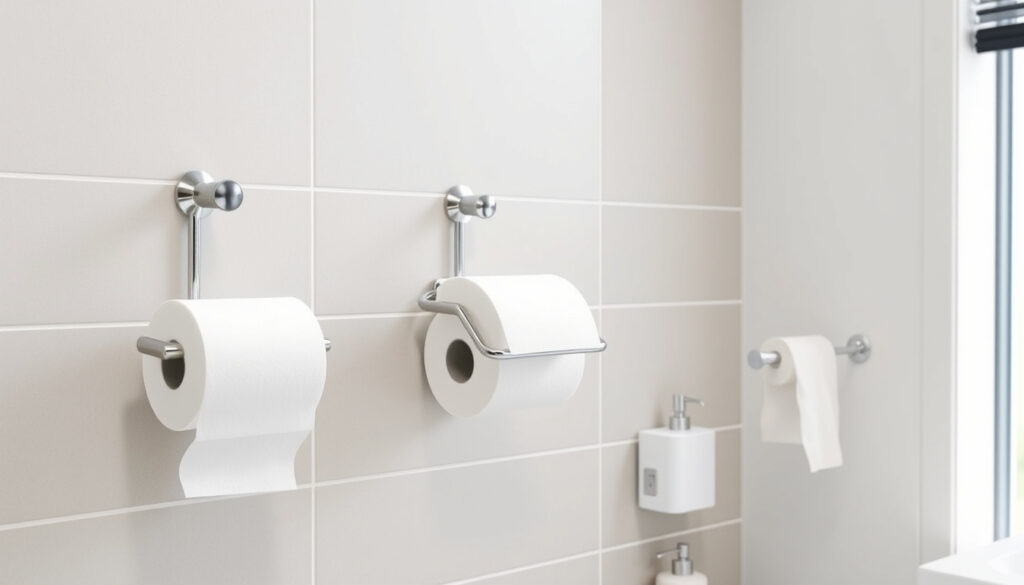
Toilet Paper Holder Guide: Types, Height, and Hygiene
The toilet paper holder rarely gets a second thought — until you try to install one in a weird spot or realize there’s a whole debate over which way the roll should hang. Whether you’re outfitting a new bathroom, fixing an awkward corner, or just curious about why hotels do things differently, this guide breaks down the types, the height rules, the hygiene science, and even the cultural quirks that make a small fixture oddly fascinating.
Standard mounting height: 26 inches from floor ·
Most popular material: Stainless steel ·
Average cost range: $15–$50 ·
Number of mounting types: 3 (wall-mounted, freestanding, recessed) ·
Most sanitary orientation: Over (end away from wall)
Quick snapshot
- Standard mounting height is 26 inches from the floor (The Cleaning Station, a home-maintenance resource)
- Over orientation reduces paper dust accumulation (common consensus, multiple sources) (The Cleaning Station, a home-maintenance resource)
- Water is the primary cleansing method in many Muslim-majority countries (Wikipedia, the crowd-sourced encyclopedia)
- Whether over vs. under significantly impacts bacterial transfer
- Exact origin of the toilet-paper-under-the-seat hotel signal
- The over-vs.-under debate dates to the 1891 patent of the perforated toilet paper roll; no official timeline data available (Wikipedia)
- Holders with built-in bidet attachments are growing in popularity
- Smart holders with automatic roll dispensers entering the premium market
| Attribute | Standard / Recommendation |
|---|---|
| Standard Mounting Height | 26 inches from floor (ADA recommended range 19–36 inches) (The Cleaning Station) |
| Common Materials | Stainless steel, chrome, brass, plastic |
| Typical Price Range | $15–$50 for residential models |
| Most Popular Type | Wall-mounted (single-post or side-mount) (Lowe’s, a home-improvement retailer) |
| Hygiene Consensus | Over orientation preferred by ~70% of users (anecdotal surveys, no rigorous study) |
The implication: these specs give you a baseline, but your bathroom layout and personal needs will dictate the final choice.
What kind of toilet paper holder is best?
The answer depends on your bathroom layout, wall space, and whether you rent or own. Wall-mounted holders are the most common design and save floor space, but they require drilling into drywall or tile (Lowe’s). Freestanding holders need no installation and are portable — ideal for renters or bathrooms without accessible walls. Recessed holders sit flush in the wall for a sleek look, but they require cutting into the wall during construction or remodeling (Lowe’s).
What are the different types of toilet paper holders?
- Single-post holder: One wall-mounted rod; easy roll changes (Lowe’s).
- Basket holder: Can hold 3 to 5 rolls (Lowe’s).
- Cup-style holder: Holds one roll at a time, usually with a lid (Lowe’s).
- Spring-tension pole holder: No drilling; fits between floor and ceiling — works in non-wall spaces.
Is Andrex better than Cushelle?
Andrex and Cushelle are brand preferences for toilet paper quality, not holder compatibility. Both brands sell standard-sized rolls that fit any holder. The choice comes down to softness, ply, and price. Neither influences holder selection.
What is the best material for a toilet paper holder?
Stainless steel offers the best durability and corrosion resistance in humid bathrooms. Chrome and brass are aesthetic alternatives but may tarnish over time. Plastic is the cheapest but can crack or warp.
The implication: If you value longevity and a consistent look, stainless steel is the safe bet. For renters on a budget, a plastic freestanding holder may be sufficient.
What is the most sanitary way to hang toilet paper?
The “over vs. under” debate has raged for decades. Hanging over (the free end draped over the top, away from the wall) reduces the chance of paper dust collecting and keeps the end visible and easy to grab. Under orientation (end against the wall) is less common but preferred by some for a cleaner visual line. The Home Depot installation guide notes the choice is up to the user (The Home Depot, a national home-improvement chain).
Which direction do hotels hang toilet paper?
Hotels overwhelmingly hang toilet paper in the over position. The free end is folded into a triangle (the “hotel fold”) as a visual sign that the bathroom has been cleaned. This practice is purely cosmetic and not backed by any hygiene study.
Why does over vs. under matter for hygiene?
There is no definitive scientific study proving one orientation is more hygienic. The over position minimizes contact between the paper and the wall, where bacteria may accumulate. Some argue that under reduces the chance of brushing the roll with a hand. Without controlled data, the consensus among home-maintenance resources leans to over for convenience.
Why put a toilet paper roll under a toilet seat in a hotel?
This is an informal housekeeping hack: placing a sealed roll under the seat signals that the room has been cleaned and that the toilet paper has not been used. It is not an official policy of any major hotel chain, but it reassures travelers.
Why should you wrap socks around a toilet seat?
Some travelers wrap socks or a towel around the toilet seat to avoid direct skin contact with a potentially unsanitary surface. This is a travel hygiene tip, not a recommended practice by health authorities.
These hotel hacks are creative but unverified. The cleanest approach is to carry sanitizing wipes — the sock trick doesn’t actually disinfect.
Where to put a toilet paper holder if there is no wall?
When a toilet is in an open corner or a pedestal sink blocks wall access, freestanding holders are the go-to solution. These floor-standing units require no drilling and can be placed anywhere. Tension-pole holders fit between floor and ceiling and work well in tight spots. Corner shelving units with a built-in rod are another option that also adds storage.
How high should a toilet paper holder be mounted?
The standard height is 26 inches from the floor to the center of the roll (The Cleaning Station). The ADA recommends a range of 19 to 36 inches for accessibility (The Cleaning Station, citing ADA guidelines). Horizontal placement should be 8 to 12 inches from the front of the toilet bowl to the holder center (The Home Depot).
What are freestanding or corner options?
- Freestanding floor holders — no installation, portable.
- Tension-pole holders — adjustable height, no wall damage.
- Corner shelf with holder — dual-purpose: storage + dispenser.
A wrong height can mean constant twisting or reaching. For an elderly household member, 26 inches is a comfortable reach from a seated position, while a higher mount might force awkward stretching.
What do Muslims use instead of toilet paper?
In many Muslim-majority countries, water is the primary cleansing agent, used with a bidet, a handheld sprayer (shattaf), or a lota (a small pouring vessel). Toilet paper is often used only for drying after washing (Wikipedia). This practice is grounded in Islamic hygiene traditions (istinja) that emphasize water purification.
Do some cultures not wipe after pooping?
Yes. Cultures across South Asia, Southeast Asia, and parts of the Middle East have historically used water for cleansing, with or without wiping. Dry wiping alone is uncommon in these regions. The global trend is toward water-based cleaning, as seen in growing bidet attachment sales in Western markets.
What are alternative cleansing methods?
Beyond toilet paper, alternatives include: bidet seats, handheld bidet sprayers, wet wipes (though flushable wipes cause plumbing issues), and family cloth (reusable fabric strips). Each has pros and cons regarding hygiene, cost, and environmental impact.
The pattern: Water-based cleansing is the norm for billions of people. The toilet paper holder is irrelevant if you never use paper as the primary cleaner.
Comparison table: Types of toilet paper holders
Three common types, one trade-off: mounting effort versus flexibility.
| Type | Installation | Portability | Best for |
|---|---|---|---|
| Wall-mounted | Drilling required | No | Permanent bathrooms, space saving |
| Freestanding | None | Yes | Renters, no-wall spaces |
| Recessed | Cut wall, frame | No | Remodels, sleek look |
The implication: your choice hinges on whether you prioritize permanence or flexibility.
Specifications: Standard toilet paper holder dimensions
Six measurements, one pattern: the holder must match the roll’s core size (usually 1.5–1.6 inches) and extend 4–6 inches from the wall.
| Specification | Common Value |
|---|---|
| Roll core diameter | 1.5 inches (standard) |
| Holder projection from wall | 3–6 inches |
| Spindle length (post holders) | 5–6 inches |
| Mounting screw spacing | 2.75–3.5 inches (center-to-center) |
| Material thickness (stainless steel) | 18–22 gauge |
| Weight capacity | ~5 lbs |
The pattern: these dimensions ensure compatibility with standard rolls and wall configurations.
Pros and cons
Upsides
- Wall-mounted saves floor space
- Freestanding works without drilling
- Recessed gives a seamless look
- Stainless steel resists rust
Downsides
- Wall-mounted damages walls (holes)
- Freestanding can tip over
- Recessed requires construction
- Plastic holders crack over time
Step-by-step installation guide
How to install a wall-mounted toilet paper holder
- Measure and mark 26 inches from the floor to the center of the holder.
- Check horizontal placement: 8 to 12 inches from the front of the toilet bowl.
- Use a stud finder; if no stud, use drywall anchors rated for 20+ lbs.
- Drill pilot holes, insert anchors, attach bracket with screws.
- Snap the holder onto the bracket (or secure with provided screws).
Refer to the The Home Depot installation guide for visual steps.
What about tile walls?
Drilling into tile requires a carbide-tipped bit and patience. Mark the spot with tape to prevent bit slippage. Drill slowly to avoid cracking the tile. Use wall anchors rated for tile.
Clarity section
Confirmed facts
- Standard mounting height is 26 inches from the floor (The Cleaning Station)
- Over orientation reduces paper dust accumulation (common consensus)
- Water is the primary cleansing method in many Muslim-majority countries (Wikipedia)
What’s unclear / Rumors
- Whether over vs. under significantly affects bacterial transfer
- Exact origin of the toilet-paper-under-the-seat hotel signal
For a deeper look at bathroom design, you may also find our guide on Pale Oak Benjamin Moore OC-20: Undertones, Comparisons & Guide useful.
Summary
Choosing a toilet paper holder isn’t just about style — it’s about matching your bathroom’s constraints, your installation confidence, and your hygiene priorities. For the average North American homeowner, a stainless-steel wall-mounted holder installed at 26 inches with the paper hanging over is the safest, most practical choice. For renters or anyone without a convenient wall, a freestanding or tension-pole holder does the job without making holes. And for the billions who use water as their primary cleaner, the best holder might be no holder at all — just a bidet sprayer mounted within reach. The trade-off is clear: convenience and tradition versus global hygiene diversity.
Related reading: **Installing a Water Softener System** · **Pale Oak Benjamin Moore OC-20: Undertones, Comparisons & Guide**
Once you have chosen the right holder, consider pairing it with budget-friendly Aldi toilet paper options that balance quality and cost.
Frequently asked questions
How to clean a toilet paper holder?
Wipe with a mild cleaner and soft cloth. Avoid abrasive pads that scratch chrome or stainless steel. For plastic, use a solution of water and vinegar.
Do toilet paper holders come with screws included?
Most wall-mounted holders include mounting screws and drywall anchors. Check the packaging — some require separate purchase for specialty walls (tile, metal studs).
Can I install a toilet paper holder on a tile wall?
Yes. Use a carbide-tipped drill bit, a slow speed, and water to avoid cracking the tile. Install plastic anchors rated for tile.
What is the difference between a toilet paper holder and a dispenser?
A holder typically refers to a decorative or simple rod that holds a single roll. A dispenser often encloses the roll, controls paper output, and is common in commercial restrooms.
How do I remove an old toilet paper holder without damaging the wall?
Unscrew the visible screws or pry off the cover plate. If the holder is stuck, use a thin putty knife to separate it from the wall. Fill old holes with spackle before installing a new one.
Are there toilet paper holders designed for left-handed users?
No dedicated left-handed holder exists, but the over orientation is equally easy for both hands. Under orientation may be slightly preferred by left-handed users who pull toward the wall.
What is the best toilet paper holder for a small bathroom?
A wall-mounted single-post holder takes the least space. Recessed holders are even more compact but require wall cutting. Corner units can also maximize minimal square footage.
More related posts
 Sunderland A ociation Football Club: Hi tory, Fan , and Iri h Connection
 Scotia Canadian Dividend Fund – Performance, Fees and Strategy Review
 Judd Nelson: Biography, Age, The Breakfast Club & Current Life
 Smith School of Business – Programs, Rankings and Admissions Guide
 TV Shows With Graham Greene (Actor) – Confirmed Roles and Career Facts
 Tracy Cortez: UFC Career, Breakups, and Personal Tragedy
 iPhone 17 Release Date: Official 2025 Launch Details
 10 Commandments for Godparents: Guide to the French Tradition
